
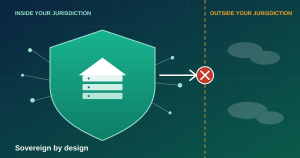
Quick answer: A sovereign AI lakehouse keeps your data, metadata, queries and AI prompts inside the jurisdiction you choose, with the control plane running where the data does. Data residency alone is not enough: if anything crosses a border you did not choose, sovereignty has leaked. The checklist below shows what to verify.
Many teams hear “data residency” and assume the job is done once storage is in-country. But data moves in more ways than files do. Metadata, query text, logs and AI prompts can all cross a border if the control plane runs somewhere else.
This article explains what a sovereign AI lakehouse is, why sovereignty is an architecture decision rather than a legal footnote, and the six questions to ask before you sign with a platform vendor.
What is a sovereign AI lakehouse?
A lakehouse unifies structured and unstructured data in one governed, query-optimised platform. A sovereign one adds a hard rule: the platform runs in-country, on a cloud the jurisdiction trusts, with the control plane next to the data.
DataNature is built this way. No metadata, query or prompt crosses a border you did not choose.
Why sovereignty matters for AI
AI raises the stakes. Prompts and retrieved context often contain the most sensitive records an organisation holds. DataNature uses a sovereign LLM substrate with no data leaving the country, plus multi-tenant isolation, so regulated organisations can use AI on real data rather than a sanitised sample.
The sovereignty checklist
- Where does the control plane run? It should run in the same jurisdiction as your data.
- Where do prompts and model calls go? A sovereign model substrate means no prompt leaves the country.
- Who can see query logs and metadata? Metadata is data. Confirm it stays in-jurisdiction too.
- Can you choose your deployment model? Public, private, hybrid, on-premises, airgap or bring-your-own-warehouse should all be options.
- Is tenant isolation built in? Multi-tenant isolation should be a design property, not a configuration afterthought.
- Can you leave? Open formats and free export keep sovereignty from turning into lock-in.
How to start
Begin by mapping one workload: its data, its rules and where it must run. DataNature’s path is an assessment in weeks 0 to 2, a first workload live in weeks 3 to 8, then scaling workload by workload with parallel runs and lineage-based reconciliation.
Every AI initiative at Nabil Bank will run on one governed lakehouse, with our data kept in Nepal.
— Nabil Bank, Nepal
🧑💻 Want to map your sovereignty requirements? Book a 15-minute walkthrough with our team. Book a walkthrough
Frequently asked questions about sovereign AI lakehouse
1. What is a sovereign AI lakehouse?
A lakehouse that runs in-country on a trusted cloud, keeping data, metadata, queries and AI prompts inside your jurisdiction, with the control plane running where the data does.
2. Is data residency the same as data sovereignty?
No. Residency is where files are stored. Sovereignty also covers where metadata, queries, logs and AI prompts go, and who controls the platform.
3. Does our data ever leave our jurisdiction?
No. The platform is sovereign by design, with a sovereign LLM substrate and multi-tenant isolation.
4. What deployment models are supported?
Public cloud (AWS, Azure, GCP, OVHcloud), private cloud, hybrid, on-premises, airgap, and bring-your-own warehouse.
Related reading
For More Info: