
Globally, most banks face one of the most significant issues with non-performing assets, or NPAs. For instance, the NPA ratio in India has decreased from 14.6% in 2018 to only 3.1% in September 2024. This indicates that financial institutions have made the transition from a primarily reactionary approach to managing credit risk to a more proactive strategy made possible by implementing AI-based early warning systems. This guide will help you prepare authoritative blog posts highlighting how AI-based platforms are offering an advantage through EWS.
The Shift to a Proactive Approach to Credit Risk Management
In many traditional banking systems, a lender would collect data through periodic reviews (monthly and quarterly). Based on this information, they would determine if someone had deteriorating credit and try to intervene before they went 90+ days overdue. By that time, the lender was already tied up in a nonproductive asset with little to no chance of recovery. The industry identifies this as “detective” risk management, where losses are generally accepted as part of doing business without trying to mitigate them proactively.
AI-powered early-warning systems have transformed this process by continuously monitoring the health and stress signals of borrowers rather than just looking back over a month or three months of data. Additionally, it allows banks to anticipate, or have foresight, into where their capital will be allocated, the amount of risk taken by each customer and how to interact with those customers.
How AI Early Warning Systems Work: The Multi-Agent Architecture
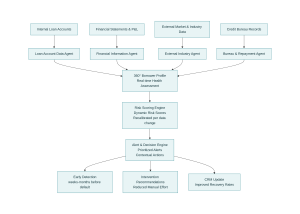
Modern EWS platforms operate on a principle of distributed intelligence. Rather than relying on a single monolithic model, they deploy specialized AI agents, each monitoring a distinct dimension of borrower health:
- Internal Loan Account Data Agent tracks repayment patterns, account utilization, transaction volumes, and behavioral deviations. It identifies liquidity strain before accounts slip into delinquency—detecting signals like reduced account activity or shortened payment cycles that precede default.
- Financial Information Agent interprets borrower financial statements, balance sheets, profit-and-loss data, and cash-flow ratios. It detects weakening fundamentals—declining profitability, shrinking working capital, deteriorating debt service capacity—that suggest financial distress.
- External Industry Data Agent monitors macroeconomic factors, sectoral performance, regulatory changes, and market sentiment. It captures industry-specific shocks (e.g., commodity price collapses, sector-wide regulatory restrictions) that can undermine even previously-healthy borrowers.
- Bureau & Repayment Agent consolidates credit bureau records, payment history, and repayment discipline. It surfaces anomalies in credit exposure, sudden inquiries suggesting desperation, and patterns of delinquency that indicate lost payment discipline.
Each agent works independently, then shares insights with others. Together, they construct a unified 360° view of borrower health. When multiple signals align—say, a borrower’s working capital ratio dips while industry outlook weakens—the system instantly alerts risk managers with context and recommended next steps.
How AI360 Studio’s Architecture Prevents NPAs: The 5-Layer System
Layer 1: Customer 360 — The Single Source of Truth
What it does: Customer 360 creates a unified, real-time view of each borrower by consolidating data across banking, lending, payments, collections, and external bureaus.
AI360 Studio features:
- Unified customer profiles across loans, transactions, repayment history, bureau data, and interactions
- Identity resolution and entity matching across systems
- Real-time and batch data ingestion
- Data quality checks, lineage, and compliance-ready audit trails
How it prevents NPAs: By eliminating data silos, Customer 360 ensures risk models and collections teams operate on a single source of truth, enabling faster identification of behavioral stress and early delinquency patterns.
Layer 2: Cognitive Search — Natural Language Risk Discovery
What it does: Cognitive Search allows risk, collections, and operations teams to query portfolio risk using natural language instead of complex SQL or BI tools.
AI360 Studio features:
- Natural language search across customer, loan, and risk datasets
- Semantic risk discovery (“show customers with rising EMI stress in the last 60 days”)
- Context-aware ranking and risk-based result prioritization
- Secure, role-based access to sensitive data
How it prevents NPAs: Cognitive Search dramatically reduces the time needed to uncover hidden NPA risk patterns, enabling proactive investigation before accounts deteriorate.
Layer 3: ML Churn Prediction — 78% Default Accuracy
What it does: This layer uses machine learning to predict borrower churn and default probability by analyzing transactional behavior, repayment velocity, and historical delinquency patterns.
AI360 Studio features:
- ML models for churn prediction, Probability of Default (PD), and Early Warning Signals (EWS)
- Time-series and survival analysis models
- Explainable AI with feature importance and counterfactuals
- Continuous retraining with outcome feedback
How it prevents NPAs: With up to 78% default prediction accuracy, AI360 Studio identifies high-risk yet recoverable customers early — allowing lenders to intervene before loans slip into 90+ DPD.
Layer 4: Intelligent Dashboards — Auto-Suggested NPA Metrics
What it does: Intelligent Dashboards automatically surface the most relevant risk and collections metrics without manual configuration.
AI360 Studio features:
- Auto-suggested KPIs based on portfolio behavior
- Real-time dashboards for NPAs, cure rates, roll rates, and vintage analysis
- Drill-downs from portfolio → segment → individual account
- Alerts for anomalies and performance drift
How it prevents NPAs: Decision-makers gain instant visibility into deteriorating segments, enabling faster corrective action and more accurate provisioning.
Layer 5: Automated Intervention Workflows
What it does: This layer converts AI insights into immediate, personalized actions across digital and human channels.
AI360 Studio features:
- Rule + AI-based decision engine
- Automated outreach via SMS, email, WhatsApp, and in-app notifications
- Personalized repayment plans and restructuring offers
- Human-in-the-loop escalation for high-risk or sensitive cases
- A/B testing of collections strategies
How it prevents NPAs: Automated, timely interventions increase cure rates, reduce roll-forward delinquency, and significantly lower NPA formation.
End-to-End NPA Prevention Workflow

- Customer data unified through Customer 360
All borrower data is consolidated into a single, real-time view, eliminating silos and ensuring accurate risk assessment. - Risk patterns discovered using Cognitive Search
Teams instantly uncover hidden risk signals using natural language queries across customer and portfolio data. - ML churn models flag high default probability accounts
Machine learning predicts which customers are likely to default early, with high accuracy, before delinquency escalates. - Intelligent dashboards highlight critical NPA metrics
Auto-suggested dashboards surface key risk indicators, enabling faster and better-informed decisions. - Automated workflows trigger personalized interventions
AI-driven actions initiate timely, tailored outreach and repayment options to prevent accounts from turning into NPAs.
Key KPIs for Measuring NPA Reduction
- Early Warning Signal (EWS) accuracy
- 30/60/90 DPD roll rates
- Cure rate after intervention
- Time-to-intervention
- Portfolio-level NPA ratio
Why AI360 Studio is built for scalable NPA prevention
- End-to-end AI-driven architecture
- Explainable and regulator-ready
- Real-time + batch decisioning
- Designed for banks, NBFCs, and fintech lenders
By combining Customer 360, Cognitive Search, ML churn prediction, intelligent dashboards, and automated intervention workflows, AI360 Studio delivers a future-ready solution to prevent NPAs at scale.
Conclusion
Preventing NPAs requires more than isolated risk models or manual dashboards. It demands an end-to-end AI early warning system that connects data, intelligence, prediction, visibility, and action in a single closed loop. AI360 Studio’s 5-layer intelligent architecture enables lenders to move from reactive collections to proactive NPA prevention, identifying stress early and intervening at the right moment.
By leveraging Customer 360 for a single source of truth, Cognitive Search for rapid risk discovery, ML churn prediction for accurate default forecasting, Intelligent Dashboards for real-time decision-making, and Automated Intervention Workflows for timely action, financial institutions can significantly reduce delinquencies and protect portfolio health.
Whether you are a bank, NBFC, or digital lender, AI360 Studio provides a scalable, explainable, and regulator-ready platform to prevent NPAs, improve cure rates, and strengthen long-term credit performance.
Call to Action
Ready to implement an AI early warning system for NPA prevention?
👉 Explore how AI360 Studio can help you detect risk early, automate interventions, and reduce NPAs at scale.
👉 Contact our team for a demo: https://dlytica.com/contact-us