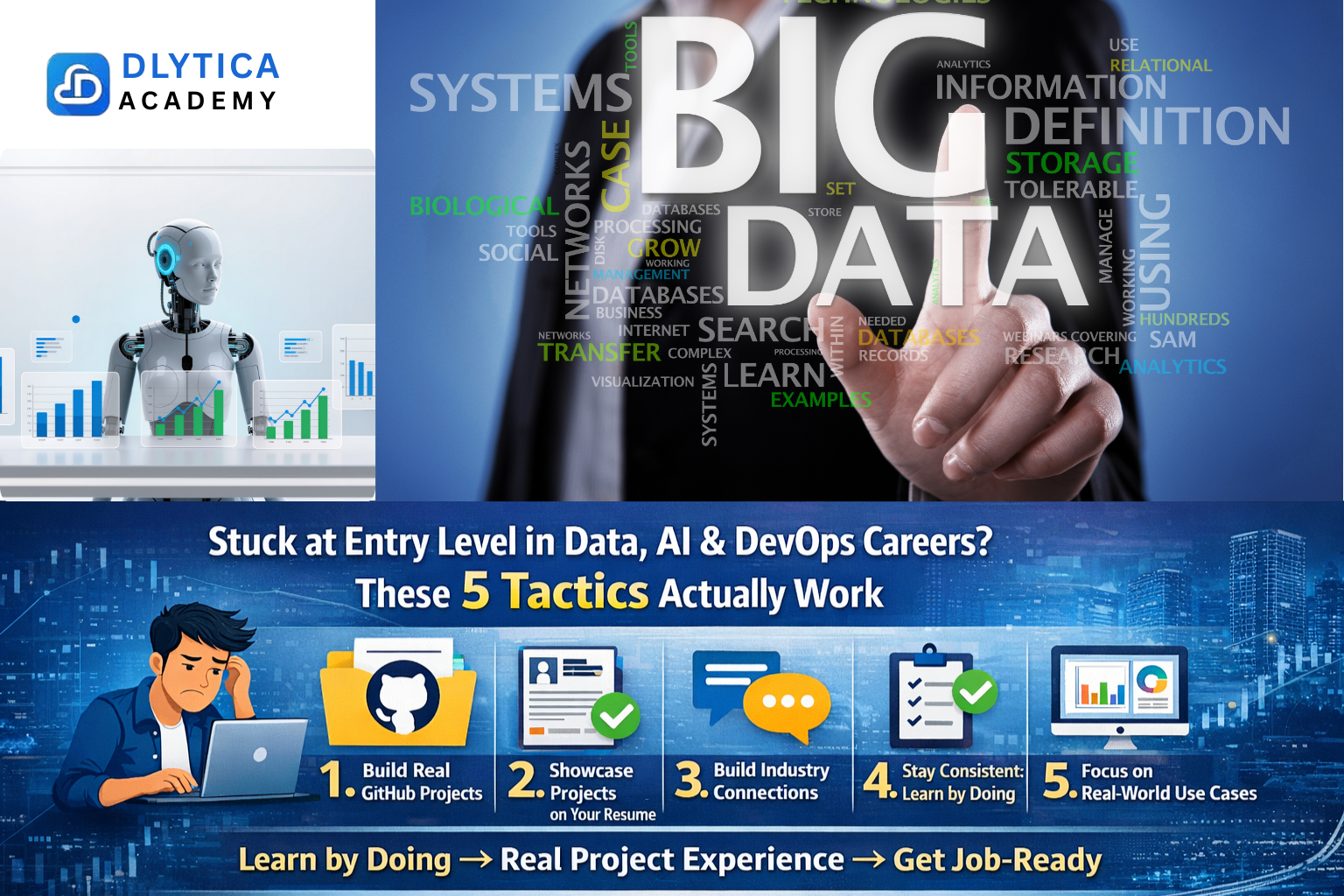
5 Proven Tactics to Land Entry-Level Data, AI & DevOps Jobs
Introduction
Have you taken an interest in learning Python, SQL, cloud basics, numerous tutorials, and obtained certificates, but job postings still ask for “1-3 years of experience”? You’re in good company. The same chicken and egg scenario with hiring is playing out in Data, AI and DevOps, where companies state they need to hire qualified candidates ready for immediate work, but the candidates do not have any real life experience to give them a chance at employment.
Short answer: Employers hire employees based on what they can see. Proof + credibility + consistency = candidates ready for employment. Below are five proven methods with real examples and copy-ready resume bullets to allow you to make progress towards this goal.
1) Build Real GitHub Projects
Why it matters. Recruiters and hiring managers scan GitHub to validate that you can deliver, use version control, and structure work for others.
What to build (not tutorial copies):
- A data pipeline that ingests CSVs or APIs, transforms data, and loads to a database.
- A mini MLOps project: training script, model artifact, simple inference API and a Dockerfile.
- DevOps automation: CI/CD workflow with test stage, build, and deployment to a staging environment (GitHub Actions example).
GitHub checklist (what hiring teams look for):
- Clear
README.mdwith project purpose, setup steps, and sample output - Small, meaningful commits with descriptive messages (show incremental progress)
requirements.txt/environment.ymlorDockerfilefor reproducibility- Tests or a smoke-check script
- One or two example datasets or scripts to download data
Example README header:
Project: ETL Pipeline for Retail Sales
Problem: Normalize daily sales CSVs from three sources and load into Postgres for analytics.
Outcome: Reduced manual prep time; processed 30k rows in under 45s.
2) Showcase Project Experience on Your Resume — don’t just list tools
Recruiters scan for demonstrated impact. Replace generic skill lists with project-focused bullets. Each bullet should answer: what you built, why it mattered, and what happened.
Resume bullet templates (copy and paste):
- Built a data ingestion pipeline using Python and Airflow to consolidate 1M+ rows/month from 3 sources, reducing manual processing time by ~70%.
- Developed a model evaluation dashboard (Streamlit) to visualize A/B model results, improving model selection time from days to hours.
- Implemented CI/CD using GitHub Actions and Docker to automate testing and deployment of microservices, enabling daily staging updates.
One-sentence portfolio blurb:
ETL → Model → Deployment. I build end-to-end pipelines that turn messy input into production-ready data products.
3) Build Industry Connections
Tactics that work:
- Contribute to small open-source projects in the ecosystem you want to join (a single PR is often noticed).
- Join topic-specific Slack/Discord groups, local meetups, or LinkedIn communities and share short, useful posts about your projects.
- Ask for 15-minute informational chats and structure them: 5 min intros, 5 min show your GitHub demo, 5 min ask for advice/referral.
4) Stay Consistent: Learn by Doing
Why consistency wins. Hiring teams prefer candidates who produce regular, incremental results — it demonstrates learning velocity and reliability.
Weekly deliverable plan (example):
- Week 1: Publish a mini-project README + dataset and make 3 commits.
- Week 2: Add a reproducible environment (Dockerfile or requirements) and a short demo video (60–90s).
- Week 3: Add small tests and CI workflow.
- Week 4: Polish README, add a one-paragraph case study and post on LinkedIn.
Small, weekly wins compound into a visible portfolio in 6–8 weeks.
5) Focus on Real-World Use Cases — teams hire for problems, not toy demos
Examples of hire-ready use cases:
- Reliable pipelines that run on schedule and recover from common errors.
- Dashboards that answer specific business questions (e.g., churn, revenue by cohort).
- Deployed models or small inference APIs with monitoring/alerts for drift.
- Scripts or automation that integrate with real services (S3, Postgres, cloud storage).
When you describe projects, explain the real decision the work supported: cost reduction, faster reporting, fewer customer escalations, etc.
The Shortcut Most People Miss: structured, team-based practice
Doing all five tactics alone is possible but slow. The fastest route is a structured program that forces:
- real projects
- peer feedback
- teamwork and code reviews
- regular delivery cadence
- industry-style use cases
That’s why traineeship and cohort-based programs (like DLytica Academy) accelerate readiness: you practice in near-production conditions and collect real artifacts hiring teams can evaluate.
Interested? Learn more about the DLytica Academy traineeship and job-focused courses here:
- Program Overview: https://www.dlytica.com/dlytica-academy
- Enroll Now: https://www.dlytica.com/course/it-career-guide
Want Details About the Upcoming Traineeship Intake?
Message our team directly on WhatsApp 👇
📍 Nepal Team
Samikshya Mudvari: +977 9709152335 https://w.app/dlyticaacademy-samikshya
Sajal Adhikari: +977 9709152334 https://wa.me/message/Q2OLUF4CTJFNB1
Bijay Rawal: +977 9709181289
🌍 USA, Canada & Other Countries
Dlytica Academy: +1 548 468 7968 | +1 437 837 0325 | +1 519 852 0929
#DlyticaAcademy #DataScience #DataAnalytics #DataEngineering #DevOps
#AI #ML #CareerUpgrade #Traineeship #Internship
Recent Post